01
Dream it.
Find an opportunity, imagine an original solution, sketch a plan, and decide how to use limited resources.
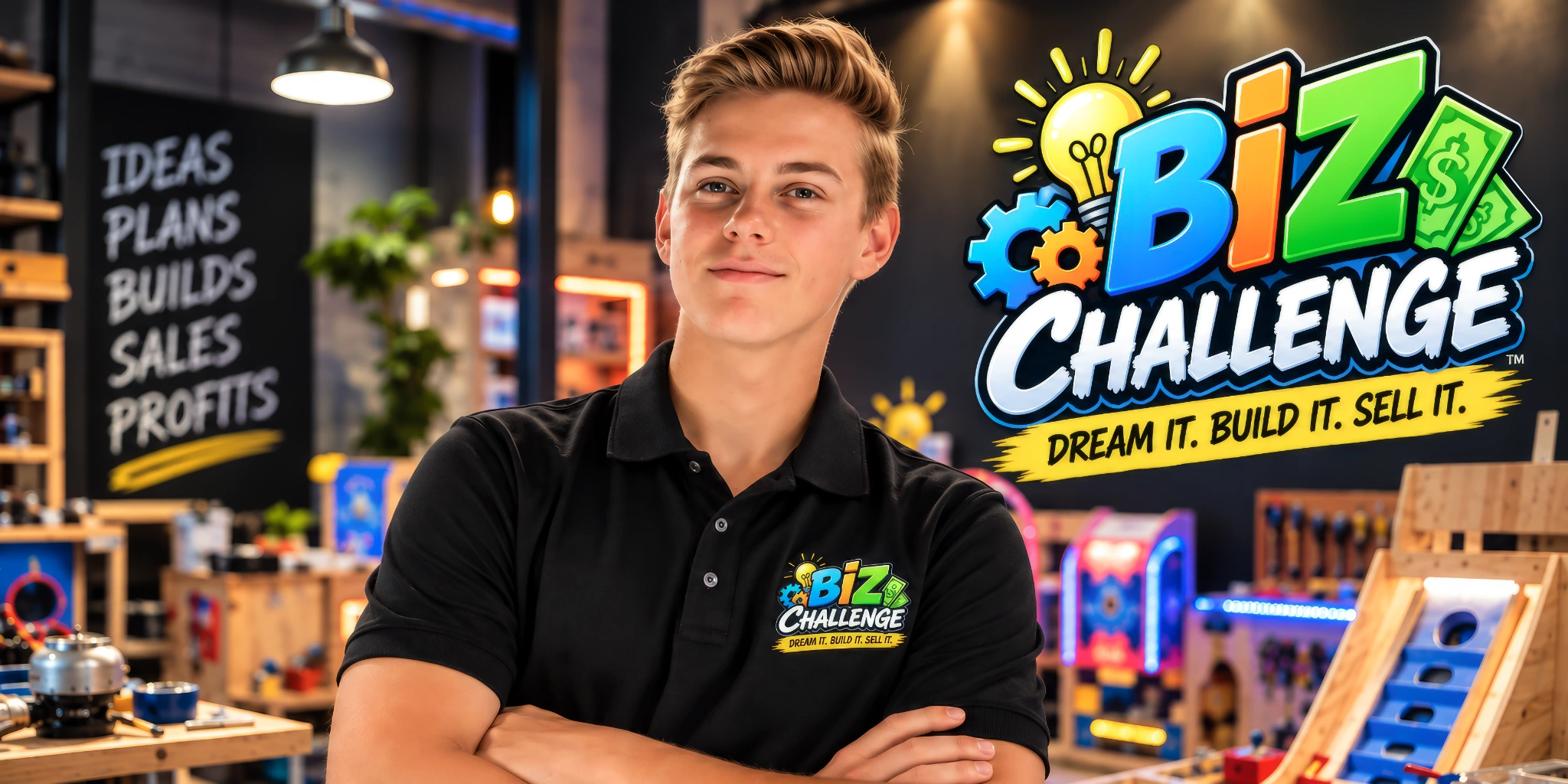
Students don't just learn about business. They create something of their own. Across a series of challenges, students conceive, design, build, test, improve, market, and sell original products or business ideas. Every decision gives classroom learning a purpose.
Biz Challenge turns students into creators, engineers, decision makers, and entrepreneurs. Each module gives them a new opportunity to turn an idea into something people can use, experience, or buy.
They plan within constraints, invest resources, solve problems as they build, test with users, and discover whether their idea connects with customers. Math, science, creativity, and communication all have a job to do.
One unforgettable experience. Learning that sticks because students put it to work.
Different challenges. The same powerful cycle of making, learning, and improving.
Find an opportunity, imagine an original solution, sketch a plan, and decide how to use limited resources.
Choose materials, measure, engineer, prototype, test, troubleshoot, and improve the product or experience.
Create a brand, set a price, explain the value, serve customers, and measure the results.
Some students will dream up a product that needs more resources than their starting budget allows. With school participation, they can earn additional simulated business cash in two ways: complete approved teacher-helper tasks in regular classes after the morning Biz Challenge session, or do agreed-upon jobs at home.
That gives them another entrepreneurial choice: scale back the idea, find a partner, or work to fund the vision.
Students use the engineering design process: sketch, measure, select materials, build, test, diagnose failures, and redesign. Depending on the challenge, they explore forces, motion, structure, mechanisms, energy, and probability.
Budgets put limits on materials and upgrades. Students calculate costs, prices, revenue, and profit, then weigh the tradeoffs of earning more simulated capital, pooling resources, splitting profits, or selling a business before launch.
Students invest resources, create an offer, face competition, and learn how customer choice, scarcity, partnerships, valuation, and risk affect the outcome.
They name and brand their idea, explain how it works, communicate its value, and learn how presentation and customer experience shape demand.
Unexpected problems become useful information. Students adapt, solve problems, lead, collaborate when working in teams, and keep improving instead of stopping at the first attempt.
They compare investment with return, examine what customers chose, and use results to decide what they would change next time.
Students have five days to create an original arcade game. Each starts with $500 in simulated startup capital to purchase materials, build and test the game, set a price, and attract players.
On launch day, each student receives $100 in simulated customer spending money to spend at other student businesses. The classroom becomes a marketplace where choices have consequences. Afterward, students calculate revenue, expenses, profit, and simulated taxes.
Arcade Day is one Biz Challenge module. Other modules use the same create, test, and sell approach with different products and business ideas.

Mikey has been building things and starting businesses since he was five years old, when he launched his first balloon-animal business. He built his own cardboard storefront, complete with a counter, signage and prices, and set it up outside his home. When he discovered brownies and lemonade attracted more customers, he reinvested his profits into ingredients and expanded his product line. He didn't know the terminology yet, but Mikey was already learning about reinvestment, customer behavior, marketing and growth.
But Mikey didn't always build things to make money. Often, he created simply because he loved figuring out how things worked. After seeing Plinko on The Price Is Right, he built his own five-foot version from cardboard, painstakingly cutting and gluing hundreds of individual pegs by hand. His love of shoes eventually led him to build a wearable pair from cardboard, then begin painting and customizing real shoes. By his early teens, Christmas lists filled with toys had been replaced by 3D printers, woodworking tools, a lathe and a laser engraver, skills he eventually turned into another business creating custom objects and furniture.
Mikey's creativity has taken him in other directions, too. As a child, he acted in movies and television, and his performance in the psychological thriller THY NEIGHBOR earned him an international acting award. Whether performing, inventing, designing, manufacturing or starting a business, the common thread has always been the same: Mikey sees possibilities, then figures out how to make them real.
That's the idea behind Biz Challenge™. Mikey doesn't want students simply reading about entrepreneurship, engineering and problem-solving. He wants them to experience it: dream up an idea, build it, make mistakes, solve problems, take risks, create something they're proud of and discover whether customers will actually buy it. Because you don't have to wait until you're an adult to start building your ideas.
Give students a reason to use STEM, math, creativity, and business skills together. They will remember what they made, what worked, and what they learned when it didn't.
Explore the experience